

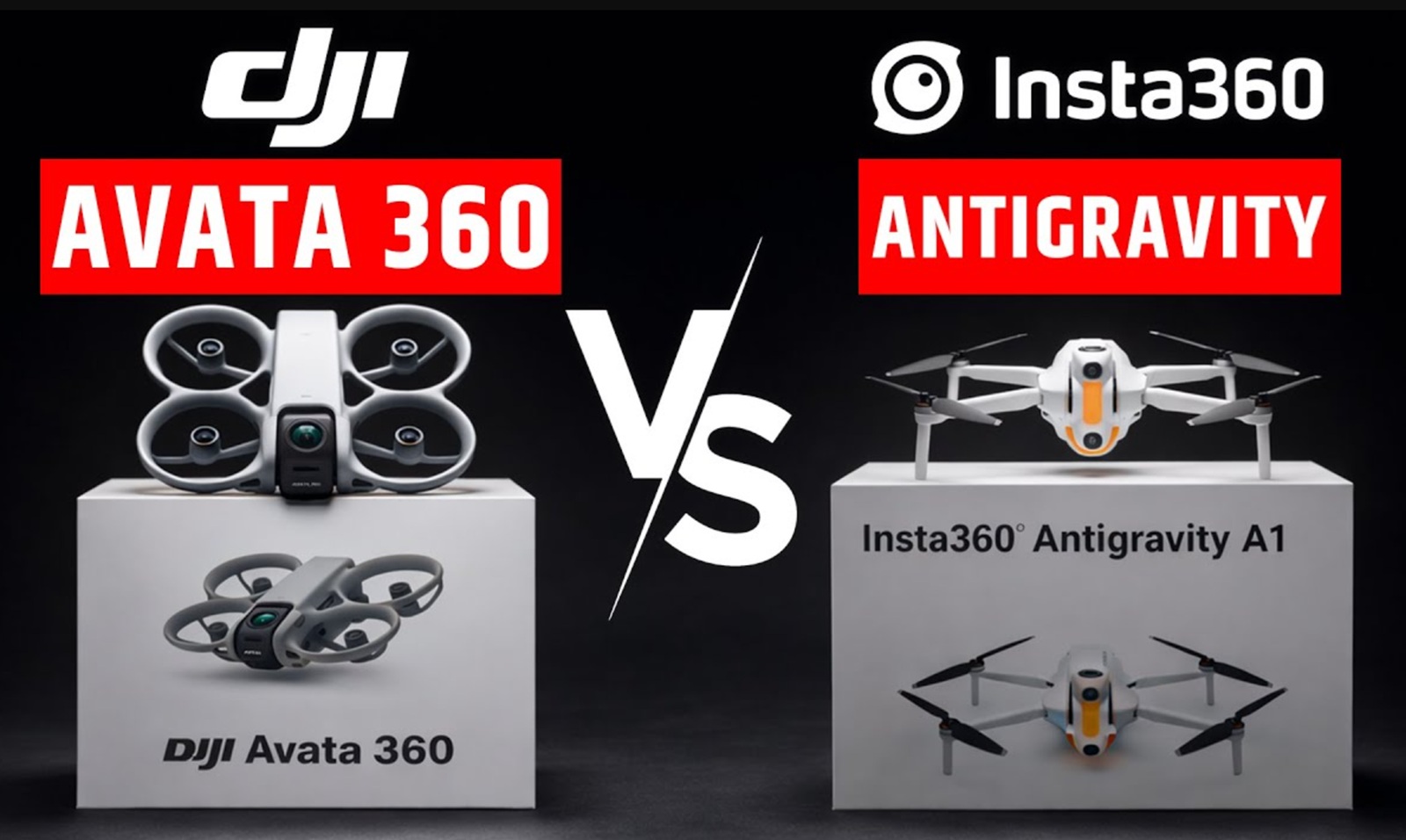
We reviewed the Antigravity A1 approximately two months ago, and since then we have received numerous comments regarding the upcoming DJI Avata 360, many of which claim it will be the ultimate 360° drone. Some of these opinions are reasonable and well-founded, while others are misleading or do not accurately reflect reality. Rather than responding to every claim individually, this article aims to provide a fair and objective evaluation of both models, clearly outlining the strengths and weaknesses of each drone based on facts and real-world considerations.
This comparison is particularly interesting because the Avata 360 is developed by DJI, widely regarded as the most innovative brand in the consumer drone market, while the Antigravity A1 is built on Insta360’s imaging technology, a company that pioneered 360° action cameras. Before drawing any conclusions, it is important to define your priorities. If drone performance is your main concern, the DJI Avata 360 will likely appeal to you more. On the other hand, if your focus is on true 360° filming, the Antigravity A1 is the option that best meets that need.
We’ve gathered the most common comments and questions from our readers about the Insta360 Antigravity A1 and the DJI Avata 360, and added our own insights. This section gives you a quick look at what people are curious about, clears up some misconceptions, and highlights the strengths and weaknesses of each drone — all in a straightforward, easy-to-understand way.
- Questions and comments regarding the Antigravity A1 pricing
- The price tag is steep the sensor is tiny.
- Over priced.
- DJI Avata 360 will be much cheaper.
- For this price I could get a far better DJI model with better specs and no bugs.
Feedback: It is common for newly released products to carry a higher price due to the significant investment in research and development. In addition, it is important to consider that the Insta360 Antigravity A1 kit includes not only the drone itself but also the FPV goggles and radio controller in the box. This all-in-one package provides a complete immersive 360° flying experience without the need for additional purchases, which adds considerable value compared to other drones that may require separate accessories to achieve similar functionality.
2. Question and comments regarding whether it is worth waiting for the DJI Avata 360 release
- I’m going to pull the trigger on DJIs Avata 360.
- I will wait for the Avata 360.
- I’m waiting for the Avata 360 from DJI.
Feedback: If your purchase is not urgent, it is perfectly reasonable to wait for the DJI Avata 360. While the Antigravity A1 is already available and offers fully verified 360° capabilities, the Avata 360 is still awaiting official release. By waiting, you may benefit from any new features, improvements, or enhancements DJI introduces, allowing you to make a more informed decision based on confirmed specifications and real-world performance once it becomes available.
3. Questions and coments regarding the Antigravity Vision Goggles
- Is there any motion sickness affect from using this drone?
- Any issues with motion sickness?.
- Those goggles are straight-up fly-like, the design choice is really confusing
- Don’t you think these goggles are super weird like a fly?
- Those fly-like goggles are so ugly I can’t get past the design.
- The goggles are so ugly they’re a dealbreaker even if the drone worked perfectly.
Feedback: Many readers have expressed concerns about the Antigravity A1’s Vision Goggles, both in terms of design and potential motion sickness. While the goggles may appear unusual at first—some comparing them to a fly-like design—their real-world experience is very different. In practice, the Vision Goggles have a sleek, modern appearance, are comfortable to wear for extended periods, and provide a clear, immersive 360° view. Unlike traditional analog FPV goggles, which can often cause motion sickness due to lower resolution or latency, the Antigravity A1’s digital system delivers smooth, high-resolution video that significantly reduces the risk of discomfort. Users can enjoy the full FPV experience without the nausea or dizziness sometimes associated with older analog setups.
Insta360 Antigravity A1 vs DJI Avata 360 comparison table
The table below provides a detailed comparison of the key specifications for the Insta360 Antigravity A1 and the DJI Avata 360. While the Antigravity A1 is fully available on the market with confirmed specifications, the DJI Avata 360 has not yet been officially revealed, and the details presented here are compiled from credible leaks and industry sources. This comparison highlights the core differences in camera capabilities, flight performance, and design, offering a clear overview for those considering either of these next-generation 360° drones.
| Antigravity A1 | Avata 360 | |
| Brand | Insta360 x Antigravity | DJI |
| Release date | December 4, 2025 | March 26, 2026 |
| Design | Foldable *(mini-style) | Whoop-style |
| Operation mode | Motion RC with goggles | Motion RC with goggles and normal RC |
| Camera | Dual 1/1.28″ CMOS | Dual 1/1.1″ CMOS |
| Video | 8K 30fps 360° | 8K 60fps 360° or 4K 60fps single lens |
| Obstacle avoidance | Front & Downward | LIDAR + Omnidirectional |
| Transmission system | OmniLink 360 | OcuSync 4.0+ |
| Range | 10KM | 20KM |
| Flight time | Up to 35 minutes | Up to 23 minutes |
| Weight | Under 250 grams | 455 grams |
| Pricing | US$1189-$1619 | $499-$1,388 |
| More details | Antigravity A1 review | DJI AVATA 360 review |
Bottom line
The Insta360 Antigravity A1 is a fully realized 360° drone offering immersive filming, 8K resolution, and a complete FPV experience right out of the box. The DJI Avata 360, while highly anticipated, remains unconfirmed with most details coming from leaks and rumors, making it difficult to draw definitive conclusions. Ultimately, your choice depends on priorities: choose the Antigravity A1 for verified 360° capture today, or keep an eye on the Avata 360 if you’re interested in DJI’s next-generation FPV 360° innovation. Stay tuned for more updates as official specifications and additional leaks become available.


Can I Mix Antigravity A1 and Insta360 Footage Together in the Same Video Editor?
Great comparison! I’m debating between these two 360 drones. If I understand correctly, you tested both drones. Which model has better comfort and ergonomics? Personally, I prefer the Antigravity Vision Goggles’ outer screen—it’s helpful during firmware upgrades and for sharing the experience with others.
I’m not spending close to 2K. Id rather spend 450 dollars for the same thing lol
Personally, I don’t like these 360 drones. I don’t see the usefulness of capturing 360 videos that you need to edit later. A friend told me that editing and exporting five minutes of footage takes about an hour for him, and it requires a supercomputer.
Many complained about the Antigravity’s range, but in practice it’s actually better than the Avata 360’s. Just a reminder that what looks good on paper isn’t always what you get in real-world flying.
The AVATA360 is noisier, heavier and bigger but also cheaper then the Antigravity A1, especially if you already have the controller from other DJI kit.
Well… the war has officially started!
DJI suing Insta360 over drone patents feels like a huge moment for the industry. Instead of competing only with new tech and better products, now it’s turning into a legal battle. As users, we might end up being the ones who lose if this slows down innovation or makes drones more expensive.
Curious to see if Insta360 fights back or backs down — this could get really big. ✈️
At over 400 grams, the Avata360 is a no‑go for Europe’s C0 classification.
Why are only “impressions” reviews available, while the full list of specifications is still kept secret? What is DJI trying to hide?
In my opinion, when it comes to design, the Avata360 clearly wins. It is much safer to fly around people and in tight spaces.
Preview videos of Avata 360 have already appeared on YouTube about an hour ago. Apparently a new tactic from their marketing department. I don’t remember them allowing clips like this to appear so early before the official announcement and then the launch. It looks like they want to buy some time so people don’t start putting their money into Antigravity :)
Either way, it looks interesting, the price will be lower than the competition, everything looks good.
I think this new competition between Insta360 and DJI will bring benefits for users. What do you think Dave?
Avata360 controller and googles compatibility?
I’m waiting with tickets to fly to other country to buy it. I hope they are on shelter by March 20. I still thinking Wich one is the best for a content creator who travel the world in a bus like myself. Worried about registering because the weight…. Come and check my journey on @buslife360
Why does the Avata 360 look almost identical to the Avata 2? Perhaps all the photos are fake?
Hi folks, I can’t decide whether to get the A1 now or wait fot the DJI AVATA 360. Advice?
This comparison between the Antigravity A1 and the DJI Avata 360 feels a bit like comparing apples to pears. The two drones approach 360° capture in completely different ways, which makes a direct matchup tricky.
The Antigravity A1 focuses on delivering true 360° recording with an invisible drone effect. Because the camera sits above the drone and uses stitching to remove the aircraft from the shot, the final footage feels clean, immersive, and unobstructed — ideal for creators who want the purest 360° experience.
The Avata 360, on the other hand, takes a different route. Its dual‑camera setup means the drone itself will almost certainly appear in the stitched footage, so it won’t achieve that fully invisible look. However, DJI added something interesting: the ability to rotate the camera and use just one lens facing forward. This gives pilots an FPV-like view that’s much closer to flying a normal FPV drone compared to traditional 360 platforms.
So while both drones target the 360 niche, they’re built with different priorities. One is about fully immersive, drone‑free footage, and the other leans into a hybrid concept—part 360 camera, part FPV aircraft.
DJI Avata 2 Fly hits Its Lowest price on Amazon, so Avata 360 coming soon!