

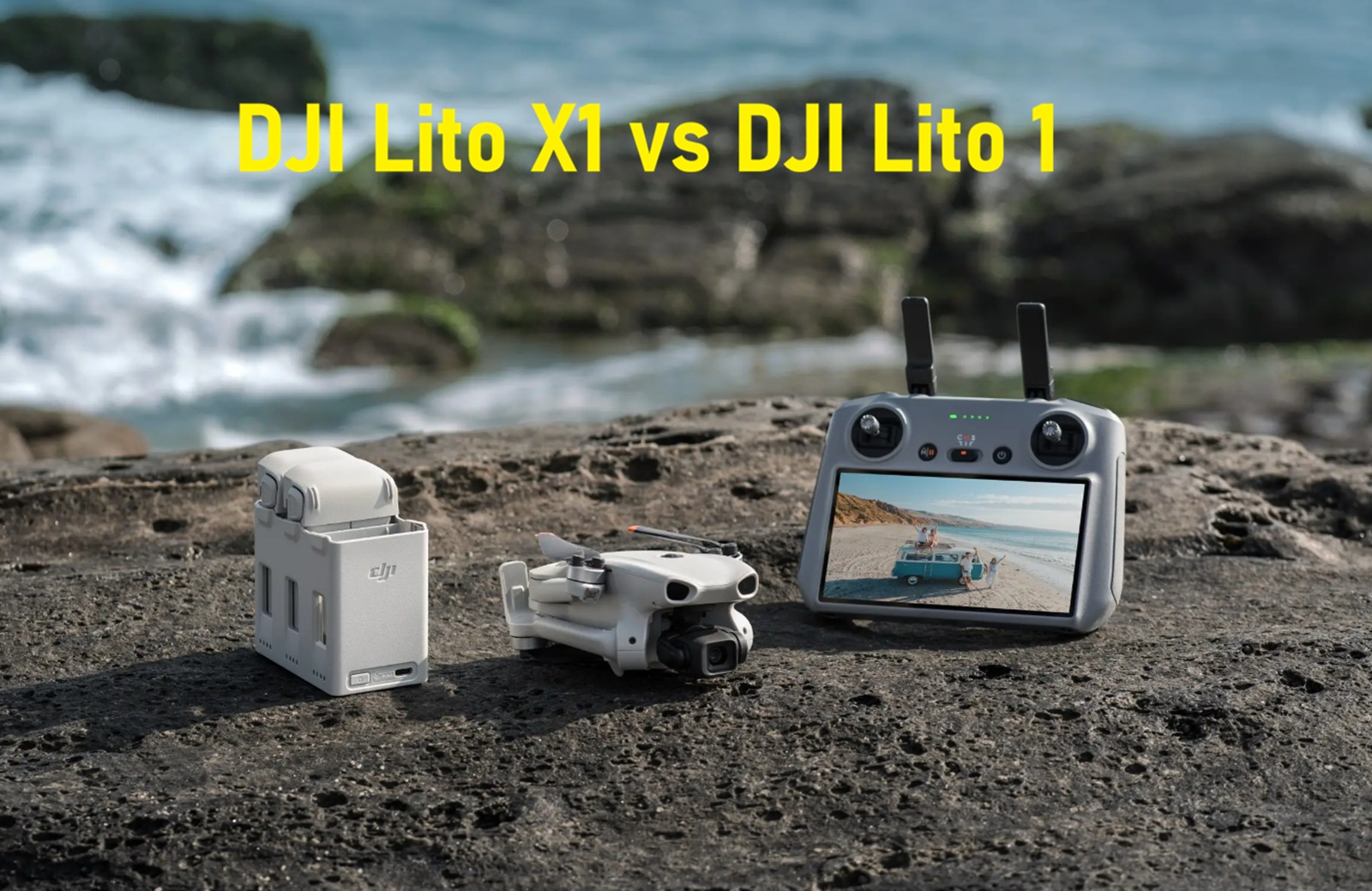
Before we dive into an in-depth comparison of the DJI Lito X1 vs DJI Lito 1, it’s worth taking a moment to understand who these drones are actually intended for and what the purpose of this new series is.
Initially, when I first read about the upcoming Lito series, I thought it might replace the iconic Mini series, now already in its fifth generation. But after reviewing the full list of specs and features, it became clear this is more of a budget-friendly alternative than a replacement. What’s even more interesting is that the Lito family isn’t available for customers in the US.
In terms of design, size, and weight, the Lito X1 and Lito 1 are identical. Both drones weigh 249 grams and measure 144 × 94 × 62 mm with folded arms. When powered by the Plus battery, the takeoff weight increases to approximately 340 grams, which places them under C1 flight regulations.
Featuring the OcuSync 4 transmission system, both models offer a range of up to 8 km in CE mode and up to 15 km under IC regulations. As mentioned earlier, the DJI Lito family does not have FCC approval.

DJI Lito X1 vs DJI Lito 1: Comparison table
The table below summarizes all the key specs and features of the Lito series, giving you a clear overview at a glance. As you’ll notice, the Lito 1 is essentially a “lite” version of the Lito X1. It comes with a more basic camera setup and a less advanced obstacle avoidance system, making it a simpler and more accessible option. While it doesn’t offer the same level of performance as the X1, it still covers the essentials well—especially for users who don’t need all the extra features and are looking for a more budget-friendly entry point into the series.
| Features | DJI Lito X1 | DJI Lito 1 |
| Image sensor | 1/1.3-inch, 48MP | 1/2-inch, 48MP |
| Lens | FOV: 82.1° Format Equivalent: 24 mm Aperture: f/1.7 Focus: 1 m to ∞ |
FOV: 79° Format Equivalent: 26.2 mm Aperture: f/1.8 Focus: 4 m to ∞ |
| Video resolutions | 4K @ 60fps HDR 4K @ 100fps 2.7K vertical |
4K @ 100fps 2.7K vertical |
| D-Log M | Yes | No |
| Internal storage | 42GB | None |
| Transmission system | Ocusync 4 (O4) | Ocusync 4 (O4) |
| Range | IC: 15 km CE: 8 km SRRC: 8 km MIC: 8 km |
IC: 15 km CE: 8 km SRRC: 8 km MIC: 8 km |
| Compatible radios | DJI RC 2 DJI RC-N3 |
DJI RC 2 DJI RC-N3 |
| Battery | Standard: 2788 mAh Plus: 4680 mAh |
Standard: 2590 mAh Plus: 4680 mAh |
| Flight time | 23 minutes (using DJI Lito X1 Intelligent Flight Battery) 37 minutes (using DJI Lito Series Intelligent Flight Battery Plus*) |
23 minutes (using DJI Lito 1 Intelligent Flight Battery) 37 minutes (using DJI Lito Series Intelligent Flight Battery Plus*) |
| Obstacle Sensing System | Omnidirectional monocular vision system, supplemented with forward-facing LiDAR and an infrared sensor at the bottom of the aircraft | Omnidirectional monocular vision system, supplemented with an infrared sensor at the bottom of the aircraft |
| Dimensiones | Folded: 144x94x62mm Unfolded: 183x251x79mm |
Folded: 144x94x62mm Unfolded: 183x251x79mm |
| Take-off weight | W/ Standard battery: ~249 g W/ Plus battery: ~340 g |
W/ Standard battery: ~249 g W/ Plus battery: ~340 g |
| Price (RC-N3|RC 2) | UK: £369|£599 EU: €379|€619 US: N/A |
UK: £299|£329 EU: €309|€339 US: N/A |
DJI Lito X1 vs DJI Lito 1: Camera Comparison
The Lito X1 clearly sits at the higher end of the lineup, and that becomes obvious once you look at the camera system. It comes equipped with a 48-megapixel Type 1/1.3″ sensor paired with a 24mm equivalent f/1.7 lens, giving it a slightly wider and more capable imaging setup.
The Lito 1 takes a more modest approach. It still offers 48-megapixel photos, but uses a smaller Type 1/2″ CMOS sensor. Alongside the full-resolution shots, both drones also capture 12-megapixel images, likely using pixel binning to improve overall detail and low-light performance—similar to what we often see in modern smartphones with comparable sensor sizes.
Because of its smaller sensor and higher crop factor, the Lito 1 ends up with a slightly different field of view, with its built-in lens coming in at a 26mm equivalent. It’s also a touch slower, with an f/1.8 aperture compared to the X1’s brighter f/1.7.
While both Lito drones are capable of recording up to 4K at 100fps, the X1 goes a step further by offering HDR video at 4K 60fps. It also includes DJI’s D-Log M color profile, giving more flexibility for color grading in post-production—something the Lito 1 does not support. Another advantage of the X1 is its built-in 42GB of internal storage, whereas the Lito 1 has none. On the other hand, both models support H.264 and H.265 compression, with a maximum bitrate of 130 Mbps, ensuring solid video quality across the lineup.
DJI Lito X1 vs DJI Lito 1: Flight performance
Featuring an identical design, weight, and propulsion system, both models offer very similar flight performance. With the standard battery, flight time is around 23 minutes, extending to approximately 37 minutes with the Plus battery. The Lito X1 is powered by a 2788 mAh battery, while the Lito 1 uses a slightly smaller 2590 mAh battery.
Both models can achieve a top horizontal speed of 18 m/s (Sport mode, using the DJI Lito X1/1 Intelligent Flight Battery) and a maximum ascent speed of 7 m/s in Sport mode.
Like most modern drones, the DJI Lito family also features an advanced obstacle avoidance system. The Lito X1 relies on an omnidirectional monocular vision system, supplemented by forward-facing LiDAR and an infrared sensor at the bottom of the aircraft. The Lito 1, on the other hand, uses an omnidirectional monocular vision system supported only by an infrared sensor at the bottom. The LiDAR system on the X1 helps ensure safer flights in low-light conditions, where vision sensors alone can struggle.
Bottom line
Choosing between the DJI Lito X1 and DJI Lito 1 doesn’t have to be complicated. If you want something straightforward that works right away, the Lito 1 won’t disappoint. But if you’re looking for a bit more performance and future-proofing—and you have a higher budget—the Lito X1 is the better long-term pick.


MINI series forever! I don’t see the point of these LITO drones.