
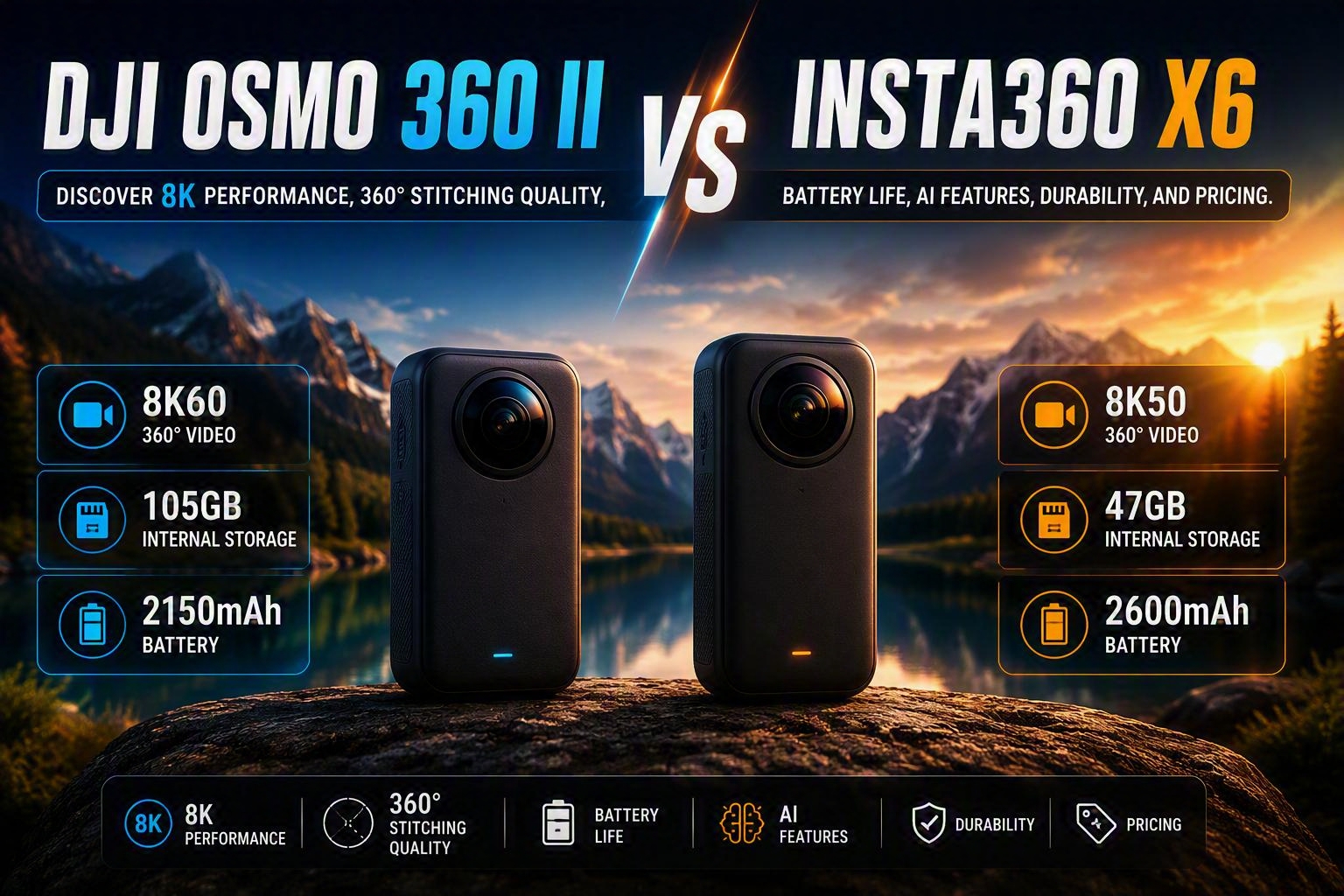
Following William’s recent Insta360 X6 vs. X5 comparison, I wanted to expand the discussion by comparing the newly released DJI Osmo 360 II against the Insta360 X6. These two cameras currently represent the top tier of the consumer 8K 360° action camera market, offering cutting-edge imaging capabilities, advanced stabilization, and powerful creator tools.
This article will provide a detailed comparison of their official specifications, features, and real-world performance. We’ll also include side-by-side test footage to evaluate image quality, low-light performance, stabilization, battery life, and overall user experience to determine which camera comes out on top.
While DJI was once primarily known for its drones and Insta360 for its 360° cameras, that distinction is beginning to fade. A few years ago, DJI expanded into the action camera market with GoPro-style products and later entered the 360° camera space with models that directly compete with Insta360’s X and GO series.
In response, Insta360 stepped into DJI’s territory by launching the Antigravity A1 drone, and I suspect this is only the beginning. With both companies now competing across multiple product categories, we can expect even more innovative and interesting models from each brand in the years ahead.

DJI Osmo 360 II vs Insta360 X6: Comparisson table
I’ve compared the key specifications of both 360° action cameras in the table below. To make the differences easier to spot, I’ve highlighted in red the categories where the DJI Osmo 360 II outperforms the Insta360 X6, and in green the areas where the Insta360 X6 holds the advantage. This color-coded approach provides a quick visual reference, helping you identify each camera’s strengths and determine which model best fits your shooting style and priorities.
| DJI Osmo 360 II | Insta360 X6 | |
| Sensor | Dual 1/1.1″ | Dual 1/1.1″ |
| Chipset | Not officially disclosed | 4nm Triple AI Octa-core |
| Touchscreen | 2.0-inch | 2.32-inch |
| Video resolutions | 360°: 8K @ 60fps Single lens: Up to 4K@120fps |
360°: 8K @ 50fps Single lens: Up to 5K@60 |
| Photo Resolution | 120 MP RAW | 120MP |
| Color depth | 10-bit | 10-bit |
| Max video bit rate | 220Mbps | 240Mbps |
| Low light mode | AI Super Night Scene 2.0 | Low Light Mode 2.0 |
| Dolby Vision | Yes | Yes |
| Audio | 4 microphones | 360 windproof mics |
| Battery | 2150 mAh | 2600mAh |
| Replaceable lenses | Yes | Yes, 2.0 |
| Waterproofing | 10 | Up to 20 meters |
| Built-in memory | 105 GB | 47 GB |
| Weight | 183 grams | 196 grams |
| Release date | 13 August 2026 (China) | 12 August 2026 |
| Availability | Limited | Wordwide |
| Price | $499 | $699.99 |
Visually, the OSMO 360 II camera has changed very little, as was already evident from several leaks. Most of the upgrades are on the technical side. According to the Chinese product page and the launch video, DJI has primarily introduced the following improvements. First, the camera now features replaceable lenses similar to the X6. Instead of the previous maximum of 8K50 for 360° recording, the camera now supports up to 8K60. Speaking of recording modes, 4K/240fps slow motion is available for 360° videos, while 4K/120fps is supported when recording with a single lens. Night shots can also be captured in 8K60 thanks to AI Super Night View 2.0 or 8K50fps for the X6 with Low Light Mode 2.0.
Bottom line
When comparing the raw specifications alone, the DJI Osmo 360 II appears to hold the edge over the Insta360 X6 in several key areas. It offers significantly more built-in storage (105GB vs. 47GB), supports higher frame rates when shooting in 8K (60fps vs 50fps), and comes in a slightly lighter package. Perhaps most importantly for many buyers, DJI has managed to undercut its rival by roughly $200, making the Osmo 360 II an exceptionally compelling option for creators who want cutting-edge performance without stretching their budget.
However, specifications tell only part of the story. Insta360 has spent nearly a decade refining its 360° camera ecosystem, building a reputation for innovation, reliability, and one of the most mature software platforms in the industry. That experience is reflected not only in the hardware itself but also in the overall user experience, from editing workflows to long-term product support. While the Osmo 360 II may win several battles on paper, the Insta360 X6 benefits from years of market leadership, making it a strong choice for users who value a proven track record and a more established 360° imaging ecosystem.