
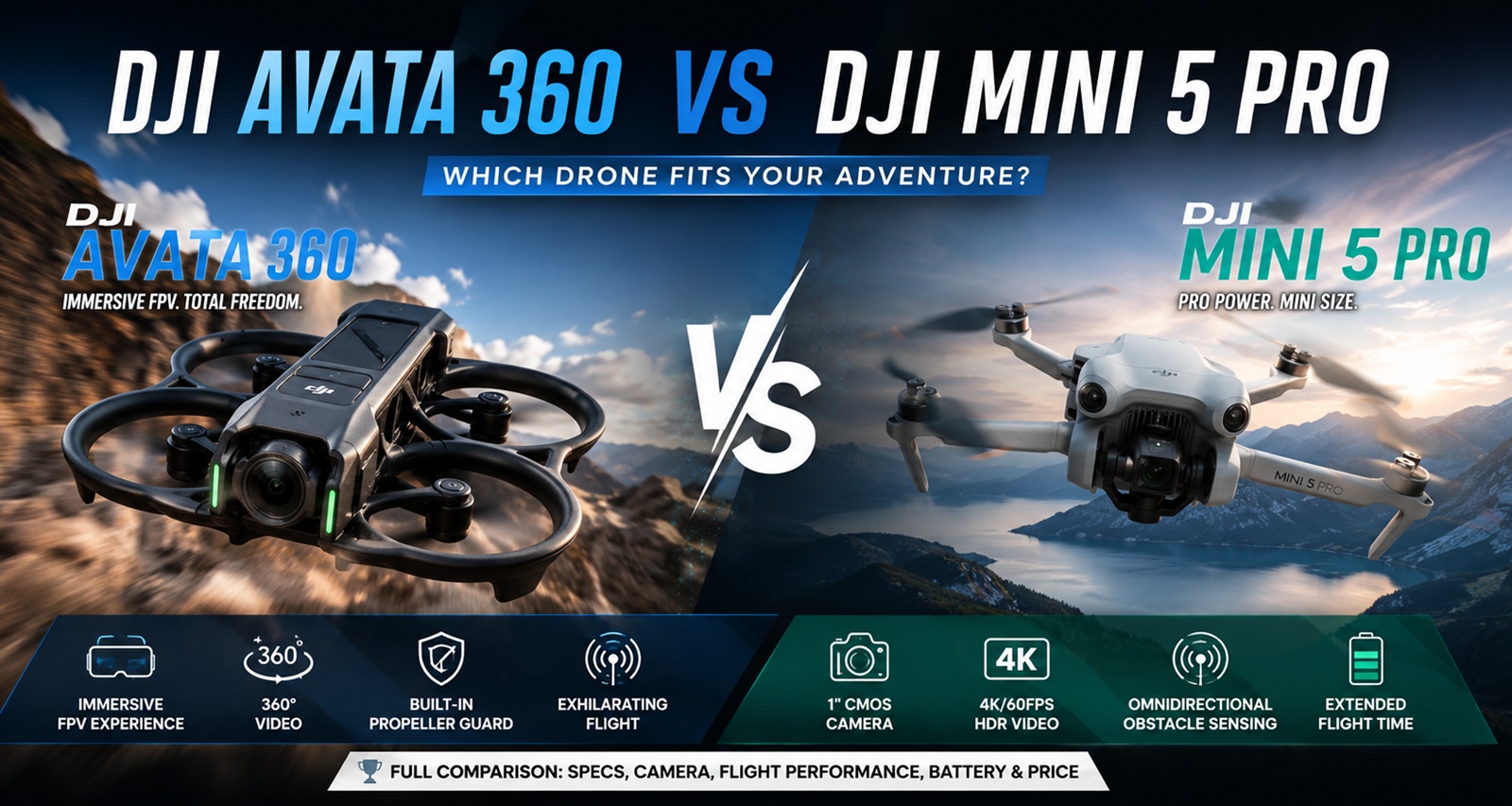
Last week, I was at a local drone store when I overheard a customer asking about the differences between the DJI Avata 360 and the DJI Mini 5 Pro. He was planning to buy his first drone and wanted to understand the advantages and disadvantages of each model before making a decision.
That conversation inspired this comparison. While these two drones fall within a similar price range (under $1000), they are designed for completely different flying experiences. In this guide, I’ll compare their features, camera capabilities, flight performance, and ideal use cases to help you decide which one is the better fit for your needs. Since I own both drones, I can also share my firsthand experience and highlight the strengths and weaknesses of each in real-world use.
I first got my hands on the DJI Mini 5 Pro, which replaced my Mini 4 Pro. While it’s currently the best sub-250 g camera drone on the market, I didn’t feel it was a major upgrade over its predecessor. The improvements are certainly welcome, but they didn’t fundamentally change the flying experience.
My first flight with the DJI Avata 360, however, was a completely different story. It changed the way I think about drone filmmaking. From a single flight, I was able to export countless camera angles and points of view without worrying about keeping the subject perfectly centered throughout the flight. The freedom to reframe shots afterward opened up creative possibilities that simply aren’t possible with a traditional camera drone.
Complete DJI Avata 360 vs DJI Mini 5 Pro Comparison Table
The table below clearly shows that these two drones differ significantly in both design and features. At nearly twice the weight of the Mini 5 Pro, the Avata 360 falls into the C1 drone class, where flight regulations are generally more restrictive than those for the sub-250 g Mini 5 Pro.
While the Mini 5 Pro is lightweight and extremely compact when folded, the Avata 360 is larger and feels more robust thanks to its Whoop-style propeller guards, which provide a real advantage when flying in tight spaces.
The Avata 360 can be flown in an immersive FPV mode when paired with the DJI Goggles 3 or Goggles N3. You can choose between the one-handed DJI RC Motion 3 controller for an intuitive flying experience and the DJI FPV Remote Controller 3 for more precise control.
| Features | AVATA 360 | MINI 5 Pro |
| Drone type | CineWhoop FPV with dual-lens 360° camera | Foldable sub250g camera drone |
| Image sensor | 120MP Dual 1/1.1″ CMOS | 50MP 1-inch CMOS |
| Gimbal | No | 3-axis with true vertical mode |
| Video resolutions | 8K/60fps HDR 360°, 6K/60fps, 4K/60fps Single Lens | 4K/120fps HDR |
| Color Profiles | D-Log M | D-Log M, HLG |
| Internal storage | 42GB | 42GB |
| Transmission system | Ocusync 4+ (O4+) | Ocusync 4+ (O4+) |
| Range | FCC: 20 km CE: 10 km SRRC: 10 km MIC: 10 km |
FCC: 20 km CE: 10 km SRRC: 10 km MIC: 10 km |
| Compatible radios | DJI RC 2 DJI RC-N3 |
DJI RC 2 DJI RC-N3 |
| Battery | Up to 23 minutes | Standard battery: Up to 36 minutes Plus battery:52 minutes |
| Obstacle Sensing System | Omnidirectional (360° mode), Forward (Single Lens) | Nightscape Omnidirectional Obstacle Sensing |
| Propeller Guards | Integrated | Optional |
| Controller Options | DJI RC 2, Goggles 3/N3 + RC Motion 3, FPV Remote Controller 3 | DJI RC-N3, DJI RC 2 |
| Takeoff Weight | 455 g | <250 g |
| Flight Class (EU C-label) | C1 | C0 |
| Release date | March 26, 2026 | September 18, 2025 |
| Drone only price | European Union: €459 United Kingdom: £399 United States: $479 |
European Union: €799 United Kingdom: £689 United States: $699 |
Side-by-Side 4K Cinematic Video Comparison
Bottom line
These two drones serve completely different purposes. The DJI Mini 5 Pro, weighing under 250 grams, offers the freedom to fly in many more places around the world with fewer regulatory restrictions. There is also no real debate that its camera delivers superior image quality compared to the Avata 360.
Both drones feature DJI’s O4+ transmission system, providing a similar control range when paired with the DJI RC 2 controller. However, when it comes to flight time, the Mini 5 Pro easily outlasts the Avata 360, offering nearly twice the airtime when equipped with the high-capacity Intelligent Flight Battery Plus.
The Avata 360 Edition isn’t a true FPV drone, as many enthusiasts would argue. One of the biggest criticisms from the FPV community is the lack of a full Manual mode, which significantly limits the flying experience for experienced pilots. Another common complaint is that the drone can only be used with the DJI RC 2 controller and Goggles 3.
In the end, I can’t say that one drone is better than the other. The right choice depends entirely on what you expect from your drone. If you want stunning aerial photography, long flight times, and maximum portability, the Mini 5 Pro is the obvious pick. If immersive first-person flying and the ability to capture every angle without worrying about framing are what excite you, the Avata 360 is in a league of its own. Or, if you don’t want to compromise, get both and enjoy the best of both worlds.