
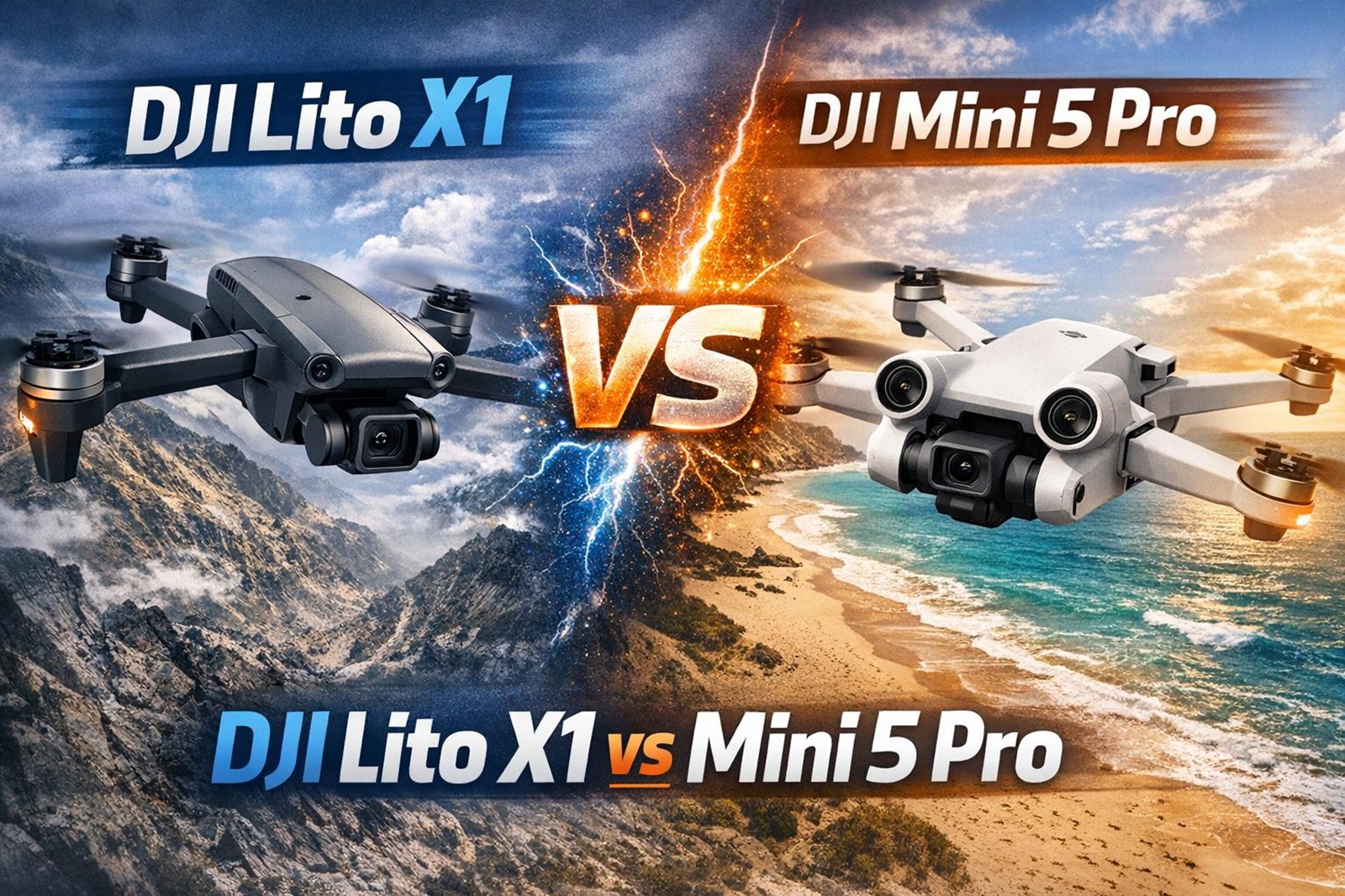
From the beginning, I can tell that DJI’s intention with the Lito X1 was not to offer a more versatile 249g drone than the Mini 5 Pro, but rather a budget alternative. The Lito series is similar to the “SE” editions, but instead of just removing features, they also created a slightly different design. While the Mini Pro series remains the flagship line with the best camera performance in its weight class, the Flip and the Lito are more accessible drones for hobbyists. From their perspective, this is profitable because you can’t use one drone as a donor for parts. Each model uses different spare parts, and trust me, repairing your drone is almost inevitable—unless you have Care Refresh.
The Mini 5 Pro was released on September 17, 2025, and the Lito X1 on April 23, 2026. You might expect that in those seven months DJI would have introduced new features, but you’ll be a bit disappointed after reading this article. The Lito X1 is just a “basic” drone compared to the Mini 5 Pro. Another negative aspect is that the Lito series does not have FCC approval, so basically you won’t find it in the US.
Both models feature an omnidirectional vision system, supported by forward-facing LiDAR and an infrared sensor on the underside of the drone. But this is where their paths begin to diverge. The Lito X1 relies on a monocular setup, with a single camera positioned on top, while the Mini 5 Pro is equipped with cameras in all directions, giving it a far more complete awareness of its surroundings. I haven’t had the chance to test the Lito X1’s obstacle avoidance system yet, but the Mini 5 Pro truly impressed me—especially when performing active tracking in a dense forest, where precision and reliability really matter.
DJI Lito X1 vs DJI MINI 5 Pro: Comparison table
If you take a moment to look at the comparison table below, the difference becomes immediately clear. The Mini 5 Pro consistently outperforms the Lito X1 across nearly every category. To make things easier to follow, I’ve highlighted in green the areas where it clearly pulls ahead—and there are quite a few.
But this isn’t just about numbers on a spec sheet. The Mini 5 Pro feels like a more refined, more capable drone in almost every way. Its camera alone sets it apart, offering not only a larger CMOS sensor but also a true vertical shooting mode, which makes a real difference for content creators. Beyond that, it’s simply a stronger performer overall—faster in the air, more efficient, and capable of longer flight times.
When you step back and look at the full picture, it’s obvious that the Mini 5 Pro isn’t just slightly better—it’s operating on a higher level.
| Features | DJI Lito X1 | DJI MINI 5 Pro |
| Image sensor | 1/1.3-inch, 48MP | 1-inch, 50MP |
| Lens | FOV: 82.1° Format Equivalent: 24 mm Aperture: f/1.7 Focus: 1 m to ∞ |
FOV: 84° Format Equivalent: 24 mm Aperture: f/1.8 Focus: 0.5 m to ∞ |
| Video resolutions | 4K @ 60fps HDR 4K @ 100fps 2.7K vertical |
4K @ 120fps FHD 1080P @ 240fps True vertical shot |
| Color mode | Normal: 8-bit 4:2:0 (H.264) 10-bit 4:2:0 (H.265)D-Log M: 10-bit 4:2:0 (H.265) |
Normal (FHD): 8-bit 4:2:0 (H.264)Normal (FHD/4K): 10-bit 4:2:0 (H.265)HLG/D-Log M: 10-bit 4:2:0 (H.265) |
| Internal storage | 42GB | 42GB |
| Transmission system | Ocusync 4 (O4) | Ocusync 4+ (O4+) |
| Range | IC: 15 km CE: 8 km SRRC: 8 km MIC: 8 km |
FCC: 20 km CE: 10 km SRRC: 10 km MIC: 10 km |
| Compatible radios | DJI RC 2 DJI RC-N3 |
DJI RC 2 DJI RC-N3 |
| Battery | Standard: 2788 mAh Plus: 4680 mAh |
Standard: 2788 mAh Plus: 4680 mAh |
| Flight time | 36 minutes (using DJI Lito X1 Intelligent Flight Battery) 52 minutes (using DJI Lito Series Intelligent Flight Battery Plus) |
36 minutes (using Mini 5 Pro Intelligent Flight Battery) 52 minutes (using Mini 5 Pro Intelligent Flight Battery Plus) |
| Max speed | Descent: 7 m/s (S mode) Ascent: 7 m/s (S mode) Horizontal: 18 m/s (S mode) |
Descent: 10 m/s (S mode) Ascent: 8 m/s (S mode) Horizontal: 19 m/s (S mode) |
| Obstacle Sensing System | Omnidirectional monocular vision system, supplemented with forward-facing LiDAR and an infrared sensor at the bottom of the aircraft | Omnidirectional binocular vision system, supplemented with forward-facing LiDAR and an infrared sensor at the bottom of the aircraft |
| Dimensiones | Folded: 144x94x62mm Unfolded: 183x251x79mm |
Folded: 157×95×68 mm Unfolded: 304×380×91 mm |
| Take-off weight | W/ Standard battery: ~249 g W/ Plus battery: ~340 g |
W/ Standard battery: ~249 g W/ Plus battery: ~300 g |
| Release date | April 23, 2026 | September 17, 2025 |
| Price (RC-N3|RC 2) | UK: £369|£599 EU: €379|€619 US: N/A |
UK: £689 EU: €809 US: $759 |
Flight Performance Breakdown: Range and Endurance
Both drones come with two battery options. There’s the standard pack (2788 mAh), designed to keep the drone under 250g and within the C0 class, and the Plus battery (4680 mAh), which prioritizes longer flight time but pushes the drone into the C1 category.
Interestingly, both models offer identical flight times on paper—up to 36 minutes with the standard battery, and up to 52 minutes with the Plus battery. According to DJI, the maximum flight distance is rated at 21 km with the standard battery and up to 32 km with the Plus version.
But as always, real-world performance tells a slightly different story. Those numbers are achieved in ideal conditions—no wind, constant speed, and perfect signal. In everyday flying, especially in places with wind or obstacles, you’ll likely see closer to 25–30 minutes on the standard battery and around 40–45 minutes with the Plus.
Range is also heavily dependent on your environment. In open areas, you can push the signal quite far, but in urban or forested locations, interference and obstacles will reduce that distance significantly. In practice, most pilots won’t come close to the advertised maximum range—and realistically, you shouldn’t, especially if you want to maintain a safe return margin.
On the other hand, when it comes to transmission distance, there is a significant difference between them. The Mini 5 Pro features the enhanced OcuSync 4+ system, while the Lito X1 only uses OcuSync O4. In FCC mode, the Mini 5 Pro has a 20 km range and 10 km in the CE region. The Lito X1 reaches up to 15 km in IC mode and 8 km in CE.
DJI Lito X1 vs DJI Mini 5 Pro: Camera Specs and Features
The biggest difference—and the most important one for content creators—is the camera. The Mini 5 Pro is equipped with a 1-inch CMOS sensor, while the Lito X1 only features a smaller 1/1.3-inch sensor. A larger sensor is almost a guarantee of better low-light performance, as it can capture more light and preserve more detail. This becomes especially noticeable in challenging conditions, where shadows, noise, and dynamic range start to matter more. The video below highlights this difference clearly, showing a side-by-side comparison of night footage captured with both drones.
Another advantage is that the Mini 5 Pro’s camera can rotate into a vertical position, allowing true 9:16 aspect ratio videos for TikTok and Instagram Reels without cropping in and losing detail. The Lito X1 also offers a vertical mode, but the resolution is reduced from 4K to 2.7K.
The Mini 5 Pro can capture 4K video at up to 120 fps, or Full HD 1080p at up to 240 fps, allowing for some truly impressive slow-motion footage. In contrast, the Lito X1 is more limited, with its frame rate going up to only 60 fps at 4K.
Bottom line
If budget is not a concern for you and you want the best aerial camera under 250 grams, the DJI Mini 5 Pro is the clear choice. It delivers top-tier image quality, advanced features, and a level of performance that stands out in its class.
On the other hand, if you are a casual hobbyist pilot without too many expectations from your drone footage, the Lito X1 can still be a great option. It offers a simpler, more affordable entry into the DJI ecosystem, making it suitable for everyday flying and basic aerial shots.
In the end, it really comes down to what you value more—premium performance and professional-grade imaging, or an accessible and budget-friendly flying experience.
What’s the difference between the Lito and the Mini 3?