
I’ve been following the evolution of Insta360 cameras for a long time, and with each new release, the company has consistently refined and improved upon its predecessor. The new Insta360 X6 brings several significant upgrades over the X5, which was released last year, further raising the bar for consumer 360° action cameras. As usual, we’ll take a detailed look at every aspect of the camera, from design and image quality to new features and real-world performance. We’ll also include an in-depth comparison between the Insta360 X6 and X5, along with side-by-side sample footage to help determine whether the latest model is a worthwhile upgrade.
Insta360 has been a major player in the consumer 360° action camera market since the launch of the ONE X in 2018. For years, the company enjoyed a dominant position in the segment, continuously refining its X-series cameras and setting the benchmark for image quality, stabilization, and ease of use. That dominance was first challenged when GoPro entered the market with the MAX 360 in 2019, bringing much-needed competition to the growing 360° camera space.
The competition intensified even further in 2025, when DJI launched the Osmo 360, its first dedicated 360° camera. With three major brands now competing in the same category, the consumer 360° camera market has become more competitive than ever, pushing innovation forward and giving creators more choices than at any point in the industry’s history.
Spoiler alert: the competition is about to heat up even more, as the DJI Osmo 360 II is expected to be released today. If the rumors are accurate, it could raise the bar once again and put even more pressure on its rivals to innovate.
What’s Improved on the Insta360 X6 Compared to the X5?
First, I should mention the new form factor. I really like that the X6 is about 20% shorter than the X5, measuring just 10 cm in height compared to the X5’s 12.5 cm. Another noticeable improvement is the new OLED display, which is brighter and easier to read outdoors than the LCD screen used on the X5. The more compact design makes the camera feel better balanced and easier to handle, especially when mounted on a selfie stick or used for long recording sessions.
Beyond the form factor, Insta360 has also focused on durability. The entire body has been redesigned, and the X6 now offers 20m waterproofing without a dive case, an improvement over the X5’s 15m rating. It also introduces Replaceable Lens 2.0, making lens replacement easier and more affordable while improving scratch resistance.
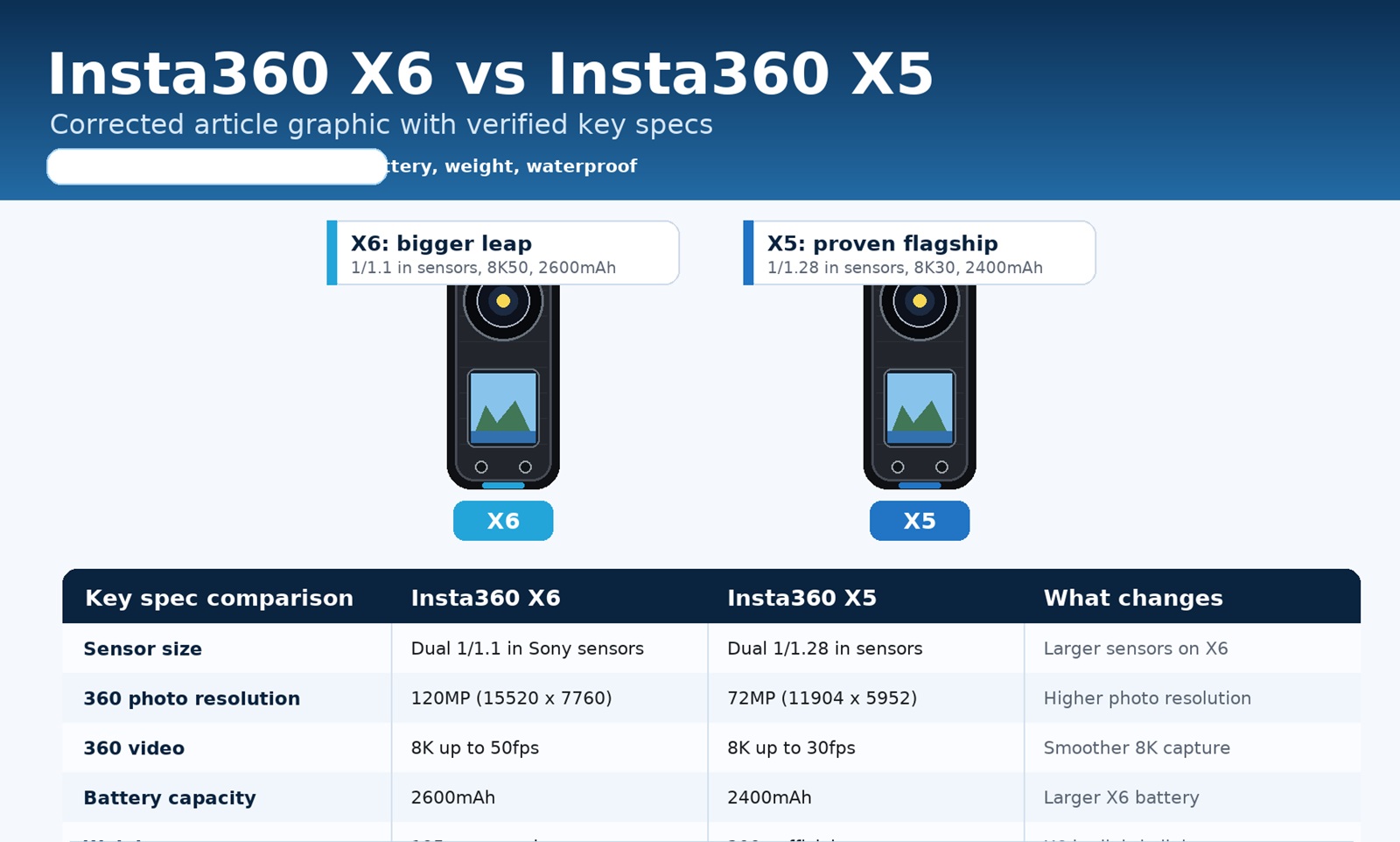
The X6 features a new AI-enabled octa-core processor built on a 4nm manufacturing process, delivering up to 500% more processing power while maintaining efficient power consumption. The camera is equipped with dual 1/1.1-inch image sensors and can capture 120MP 360° photos, while the X5 uses smaller 1/1.28-inch sensors and is limited to 72MP 360° photos. This combination of larger sensors and increased processing power should provide noticeable improvements in image quality, dynamic range, and low-light performance.
When it comes to video, the Insta360 X6 can record 8K 360° video at up to 50fps and supports 5K at 60fps in single-lens mode. In comparison, the X5 is limited to 8K 360° recording at 30fps and does not offer a 5K single-lens recording mode. These upgrades make the X6 a more versatile camera for creators who need smoother footage, higher frame rates, and greater flexibility when switching between 360° and traditional action camera shooting.
Insta360 X6 vs Insta360 X5 comparisson table
If you’re wondering whether the jump from the Insta360 X5 to the new X6 is worth it, the comparison table below breaks down the most important differences. While both cameras follow the same 360° action camera formula, the X6 introduces several meaningful upgrades that go beyond a simple refresh.
Thanks to its larger image sensor and more powerful AI-driven octa-core processor, the X6 delivers improved image quality, better dynamic range, enhanced low-light performance, richer 10-bit color, and higher recording bitrates. Another major change is the physical design. The X6 adopts a completely new form factor, making it noticeably different from its predecessor in both appearance and handling.
| Features | Insta360 X6 Inspiration in every direction |
Insta360 X5 All day. All night. All angles |
| Sensor | Dual 1/1.1″ | Dual 1/1.28″ |
| Chipset | 4nm Triple AI Octa-core | 5nm Triple AI |
| Touchscreen | OLED 2.32-inch | LCD 2.5-inch |
| Video resolutions | 360°: 8K @ 50fps Single lens: Up to 5K@60 |
360°: 8K @ 30fps Single lens: Up to 4K@120 |
| Photo Resolution | 120MP | 72MP |
| Color depth | 10-bit | 8-bit |
| Max video bit rate | 240Mbps | 180Mbps |
| Low light mode | Low Light Mode 2.0 | Low Light Mode 1.0 |
| Dolby Vision | Yes | No |
| Audio | 360 windproof mics | 4-mic spatial audio |
| Battery | 2600mAh | 2400mah |
| Replaceable lenses | Yes, 2.0 | Yes |
| Waterproofing | Up to 20 meters | Up to 15 meters |
| Built-in memory | 47GB | No |
| Dimensions | 100 × 50 x 40 mm | 124.5 × 46.0 x 38 mm |
| Weight | 196 grams | 200 grams |
| Release date | 12 August 2026 | 22 April 2025 |
| Price (MSRP) | $699.99 €689 |
$549.99 €589 |
Insta360 X6 vs X5: 20+ comparison tests
Bottom line
I think the higher price of the Insta360 X6 over the X5 is justified, as it brings meaningful upgrades that improve both image quality and the overall user experience. The larger sensor (120MP 1/1.1″ vs 70MP 1/1.28″), more powerful AI-enabled processor (4nm with 500% more computing power vs 5nm), and enhanced imaging capabilities deliver noticeable gains in detail, color reproduction, and low-light performance. The new, more compact form factor will also be appreciated by users who prefer to travel light, while the OLED touchscreen offers better visibility and responsiveness in bright daylight conditions.
That said, before you pull the trigger, I would recommend waiting to see what the DJI Osmo 360 II has to offer. Expected to be released today, it could provide strong competition at a more attractive price point.
Lastly, I’m curious if Insta360 is planning to put its new technology on a 360 drone, and whether we can soon expect an upgraded version of the Antigravity A1 as well.